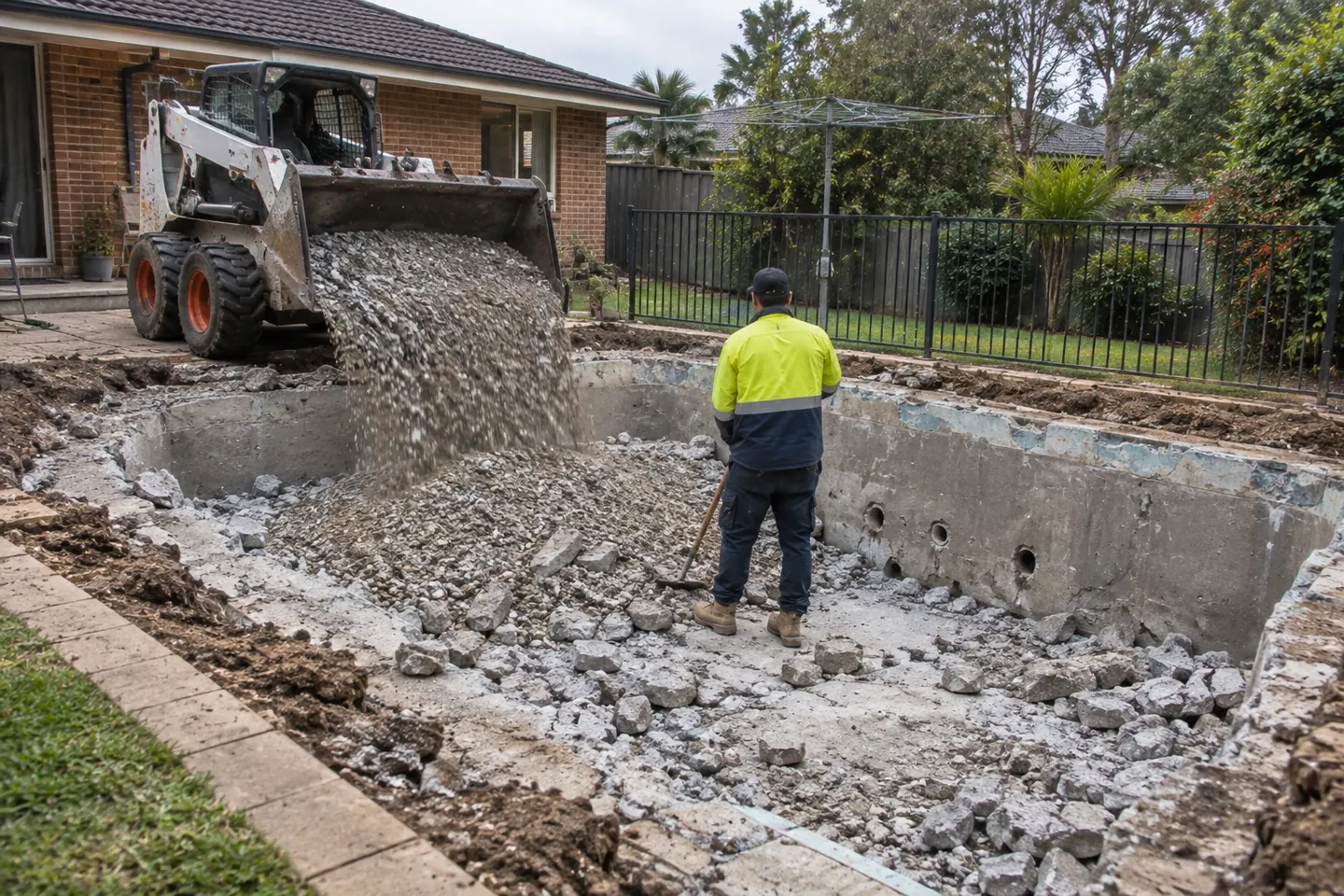
What happens in a fill-in
1. Drain the pool in line with local requirements.
2. Break the floor. The floor is broken or holed so water does not collect in the buried shell like a bathtub.
3. Remove the top of the walls. Walls are taken down below finished ground level so nothing protrudes through the lawn later.
4. Remove surrounds — coping, paving, equipment.
5. Fill in layers. Suitable material placed and compacted.
6. Topsoil and finish for turf or gardens.
When a fill-in makes sense
- You want lawn, garden or a play area.
- You have no intention of building over the spot.
- Budget matters more than future flexibility.
- Access is difficult and carting a whole shell would be very expensive.
When it does not
- A granny flat, extension or garage is on the cards.
- You are planning a knock-down-rebuild.
- You are selling soon and want no questions.
- The ground has drainage issues already.
In those cases, see full removal.
The two things that go wrong
Poor drainage. If the floor is not broken properly, the buried shell holds water. The lawn turns to a bog and can smell.
Poor compaction. Tipping fill in all at once leads to settlement. The lawn sinks into a pool-shaped hollow over the next wet season.
Both are avoided with the right method.
Fibreglass pools
Fill-ins are more common for concrete pools. Fibreglass shells are usually removed completely because the extra cost is small. See fibreglass pool removal.
Approvals and the barrier
Filling in a pool in NSW commonly requires approval, and the pool barrier stays until the pool can no longer hold water. See council and approvals.
Costs
See the 2026 cost bands.
Call 02 6422 4202 or send your pool details through.
Two ways to get rid of a pool
Full removal
Shell out, compacted backfill. Costs more. Keeps building options open and leaves nothing buried.
Fill-in
Floor broken, walls cut down, shell filled. Costs less. Best for lawn and garden only.
Questions people ask before they commit
How does a pool fill-in work?
The pool is drained, the floor is broken or holed so water can drain through, the upper section of the walls is removed below finished ground level, and the shell is filled with suitable material in compacted layers, finished with topsoil.
How much does it cost to fill in a pool in Sydney?
As a 2026 guide, a concrete pool fill-in commonly runs $9,000 to $20,000 depending on size, access, how much wall is removed and the fill required. It is typically cheaper than full removal because much less concrete is carted away.
Can I build over a filled-in pool?
It is often restricted. The buried shell and fill may not suit footings, and engineers may require the remaining shell to be removed or specific footing designs used. If building over the area is at all likely, full removal is usually the better choice.
Do I have to tell buyers about a filled-in pool?
Buyers and their advisers may ask about it, and it may affect their plans for the land. Keep records of the approval, method and backfill. Get advice from your conveyancer or solicitor about disclosure obligations when selling.